This article provides a more detailed exploration of the topics addressed in the summary published here.
Most CEOs say AI is a top priority, but the evidence says otherwise. The majority are running an AI portfolio—a collection of pilots, proofs of concept, and productivity add-ons—that looks like progress without changing how the business competes. That is not a transformation. And the companies that know the difference are pulling ahead in ways that make it hard to catch up.
CEOs are frustrated, and they should be. Bain’s 2026 CEO survey finds that roughly 80% of chief executives are dissatisfied with the pace of their AI programs. And around 85% of companies are not executing well. That dissatisfaction says less about what the technology can do and more about how leaders are designing and running their transformation programs.
80
of CEOs are unhappy with the pace of their AI transformation programs
85
of companies are not executing well
The emerging leaders are not running better pilots. They are operating on a different logic and building proprietary intelligence that puts them on a different curve entirely. They have made explicit, board-level bets on several domains where AI reshapes their competitive economics, and they are rebuilding those domains from scratch, not retrofitting AI onto legacy workflows. They treat data, agentic software capability, and organizational learning as strategic assets that compound in value. They are making a commitment, not managing a portfolio.
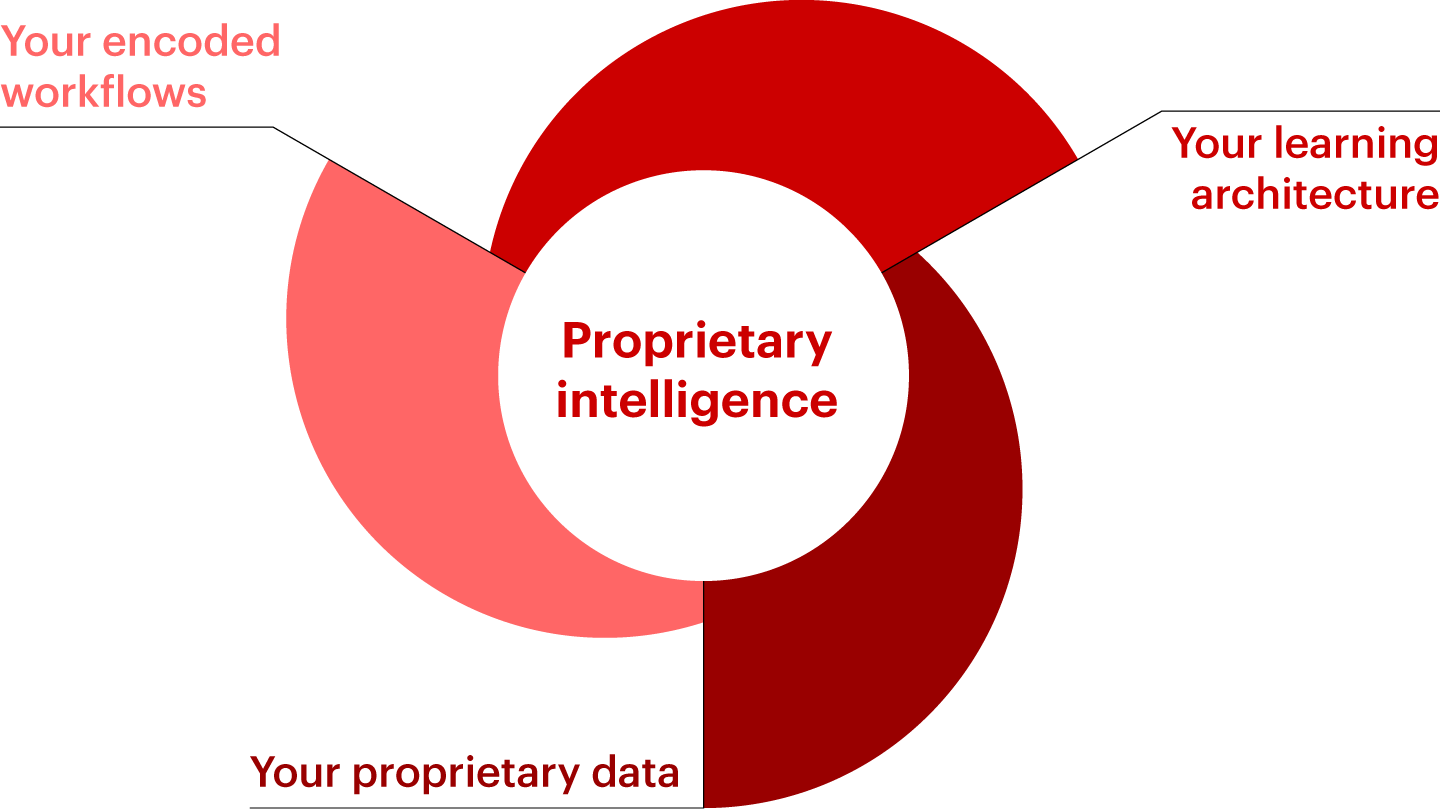
The result is proprietary intelligence, built on three things that competitors will struggle to copy:
Proprietary data—the accumulated record of customers, operations, and outcomes that belongs to the organization alone and grows more valuable with every transaction, interaction, and decision.
Encoded workflows—the institutional knowledge of how the business wins, drawn from human judgment and embedded into agents that execute it at scale.
Learning architecture—the closed loops between human judgment and AI output that make every deployment smarter than the last, delivering an advantage that widens with use and cannot be closed by writing a bigger check.
Better data sharpens the agents, sharper agents raise the performance of the people working alongside them, those people re-encode what they learn into the next generation of workflows, and those workflows generate still better data. Each cycle pulls further ahead. That is what makes this different from prior technology waves, and what makes the cost of hesitation so high.
The enterprise AI operating system: proprietary intelligence is your moat
Seven decisions that define AI transformation leaders
This paper is written for CEOs who want to close that gap. It is not a technology brief. It is a strategic leadership guide, organized around seven decisions that separate emerging leaders. Each section lays out the decision, names the most common failure mode, and tells you what you need to do differently. The goal is not to add to the noise about AI’s potential. It is to be honest and clear about what transformation actually requires.
The window to act is open, but not indefinitely. The structural advantages that AI leaders are building compound over time, making it increasingly difficult for followers to close the gap. The cost of waiting is falling further behind at an accelerating rate.
1
Posture
Commit at the board level or don't bother; execute aligned to the posture
2
Domain focus
Concentrate on 3–5 bets where AI changes the economics
Capability pillars
3
Data moat
Build the proprietary moat
4
Technology architecture
Own the orchestration layer
5
5–10x operating model
Design for speed; build the culture to sustain it
6
Learnings
Make the transformation compound on itself
7
Governance
Embed accountability, funding, and pace aligned to posture